Evaluation of Antioxidant and Cytotoxic Activity of Plants Allium Ponticum and Allium Saxatile, Growing in Georgia
DOI:
https://doi.org/10.52340/GBMN.2023.01.01.02Keywords:
Allium ponticum, Allium saxatile, Allium, antioxidant activity, cytotoxicityAbstract
BACKGROUND. Plants of the genus Allium have a long history of traditional use worldwide, dating back to the early ages, as food and medicine. The Allium genus has been recognized as a rich source of secondary metabolites with related health benefits. Allium species are widely used in Georgian traditional medicine against many diseases. OBJECTIVES In this research, we have evaluated the antioxidant and cytotoxic activity of Allium ponticum Miscz, Sect. Allium and Allium saxatile M. Bieb, Sect. Oreiprason F. Hern. Two Allium species growing in Georgia. METHODS Ethanol extracts from both plants were obtained, using an ultrasonic water bath. The dried ethanol extract was subjected to fractionation using column chromatography, with Water-Methanol as a mobile phase. The cytotoxic properties of all these extracts and fractions were evaluated against human melanoma cells (A2058). The antioxidant activity of fractions was evaluated using the TBARS assay on RAW 264.7 murine macrophages. The anti-inflammatory activity of extracts and fractions was studied using RT-qPCR, and the inflammation was induced with LPS (Lipopolysaccharide). RESULTS The crude extract of A. saxatile showed cytotoxic activity with IC50 value of 37.62 μg/ml, 100% methanolic fractions of A. saxatile and A. ponticum showed activity with IC50 4.04 μg/ml and 37.67 μg/ml respectively. Among the fractions, 50% methanolic fraction had better activity than others, IC50 _ 2.93 μg/ml and 14.78 μg/ml for A. saxatile F2 and A. ponticum F2, respectively, Doxorubicin 5 µM. The results of antioxidant activity were IC50_ 3.5 μg/ml and 58.48 μg/ml for crude extracts of A. saxatile and A. ponticum respectively. Extracts and fractions haven’t expressed an anti-inflammatory activity. CONCLUSIONS Overall, these data confirm the therapeutic potential of Allium ponticum and Allium saxatile, and the need for the isolation of individual compounds, which are responsible for these biological activities.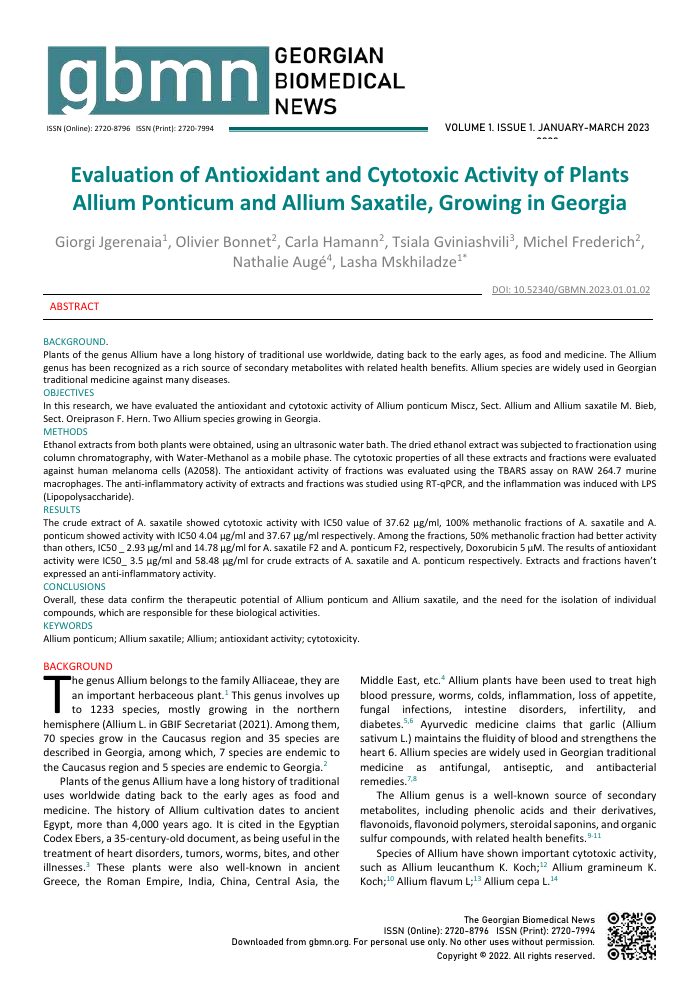
Downloads
Published
2023-02-03
How to Cite
Jgerenaia, G., Bonnet, O., Hamann, C., Gviniashvili, T., Frederich, M., Augé, N., & Mskhiladze, L. (2023). Evaluation of Antioxidant and Cytotoxic Activity of Plants Allium Ponticum and Allium Saxatile, Growing in Georgia. Georgian Biomedical and Medical Nexus, 1(1), 7-13. https://doi.org/10.52340/GBMN.2023.01.01.02