Comparative safety study of the phenolic constituents of smokebush (Cotinus coggygria) leaves
DOI:
https://doi.org/10.52340/GBMN.2023.01.01.15Keywords:
Cotinus coggygria, endodontic irrigation, tannins, toxicityAbstract
Background: The extract (CPLSB) from the smokebush (Cotinus coggygria) leaves is recommended as the endodontic irrigation solution, and its purified fraction contains mainly hydrolyzable tannins (PFTLSB). Objectives: The purpose of the present study was to define the safety margins as well as the potential irritative and allergenic effects of a polyphenol-containing extract (CPLSB) from the smokebush (Cotinus coggygria) leaves. Methods: The experiments were conducted following the OECD Guidelines for Chemical Testing, followed by probit analysis to precisely establish the median lethal doses (LD50) of CPLSB and PFTLSB. Results: The LD50 of CPLSB following intraperitoneal and oral dosing in mice was found to be 19 mg/kg and 389 mg/kg, respectively. LD50 of PFTLSB in a similar experiment was 46 mg/kg and 720 mg/kg. Both compositions revealed no signs of toxicity, and the absence of local irritative or allergic reactions was observed as well. Conclusions: PFTLSB is safer for the intended use because it appears to be almost twice as non-toxic as CPLSB, the maximum oral irrigant dose of which varies between 7 and 14 mg/kg.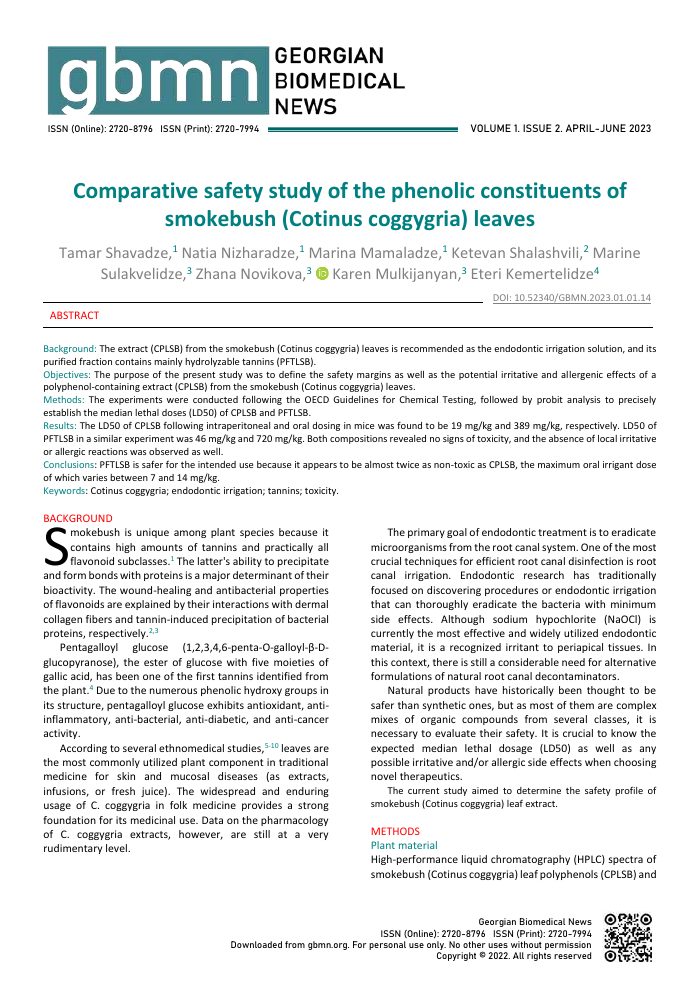
Downloads
Published
2023-04-10
Issue
Section
Original Research
Categories
How to Cite
Shavadze, T., Nizharadze, N., Mamaladze, M., Shalashvili, K., Sulakvelidze, M., Novikova, Z., Mulkijanyan, K., & Kemertelidze, E. (2023). Comparative safety study of the phenolic constituents of smokebush (Cotinus coggygria) leaves. Georgian Biomedical and Medical Nexus, 1(2), 60-63. https://doi.org/10.52340/GBMN.2023.01.01.15