
Analysis of the Diagnostic Markers in Patients with Post-COVID-19 Disorders
DOI:
https://doi.org/10.52340/GBMN.2023.01.01.22Keywords:
post-COVID-19 disorders, laboratory markersAbstract
Background: The post-COVID complications have turned out to be an urgent problem. Most patients suffered from dry, lingering cough of assault character, shortness of breath, sweating, weakness, fatigue, and other symptoms and signs. There is a need to study the functional status of the respiratory system and provide permanent monitoring of laboratory markers among patients with post-COVID-19 disorders. Objectives: The study aimed to evaluate the functional status of the respiratory system and laboratory markers among Georgian patients with post-COVID-19 disorders. Methods: 157 patients (18 to 75 years of age, 88 women and 69 men) with post-COVID-19 disorders were involved in the study and evaluated according to the following plan: (i) collection of anamnesis; (ii) assessment of the functional state of external respiration performed by a modern, computerized spirometer - Spirolab 3; (iii) analysis of laboratory markers, such as D-dimer, coagulogram, C-reactive protein (CRP), procalcitonin, interleukin-6 (IL-6), total IgE and vitamin D. Based on the obtained results, the patients were distributed among two groups: 101 (64%) patients with post-COVID-19 respiratory disorders in study group I, and 56 (36%) patients without post-COVID-19 disorders - in control group II. Results: No reliable changes (p<0.05) in the spirometry parameters (FEV1; FVC; FEV1/ FVC) were observed in the study group. PEF < 70% peak expiratory flow was reduced in only 43 (42%) patients, compared to the norm. Mild restriction and irreversible obstruction were observed in 25 (24%) cases. In the control group, the spirometry indicators varied within the referral ranges. Among the correlogram markers, fibrinogen concentration was increased in most cases, namely in 51 (50%) patients. In addition, in 35 (34%) of 157 patients studied, a slight increase in the DD marker was revealed (218.5 ±2.45 (norm < 200)); It should be emphasized that the increase in CRP was observed in 16 (15%) patients involved in this study; Only 2 (1.9%) patients with complicated respiratory changes showed a slight increase in procalcitonin levels. Detection of interleukin-6 showed an increase in the level of this marker in 38 (37 %) patients, while in the patients of the control group, changes in the markers mentioned above were revealed in single case: fibrinogen level in 4 (7%); DD - 9 (16%); CRP - 2 (1.9%); procalcitonin - 2(1.9%); Interleukin-6 - in 5 (8.9%), respectively. The allergy marker total IgE was revealed in 34 (33%) of the studied patients, while among the control group patients, it was fixed in 12 (21%). Vitamin D insufficiency was detected in 31 (31%) patients, deficiency in 35 (35%), and normal level in only 34 (34%) patients, respectively. In contrast, in the control group, insufficiency was detected only in 11 (19.7%), deficiency in 15 (26.8%), and norm in 30 (53.5%) patients. Conclusions: The study has shown the necessity of monitoring laboratory biomarkers such as vitamin D, IL-6, and total IgE, as well as conducting computerized spirometry in patients with post-COVID-19 respiratory disorders.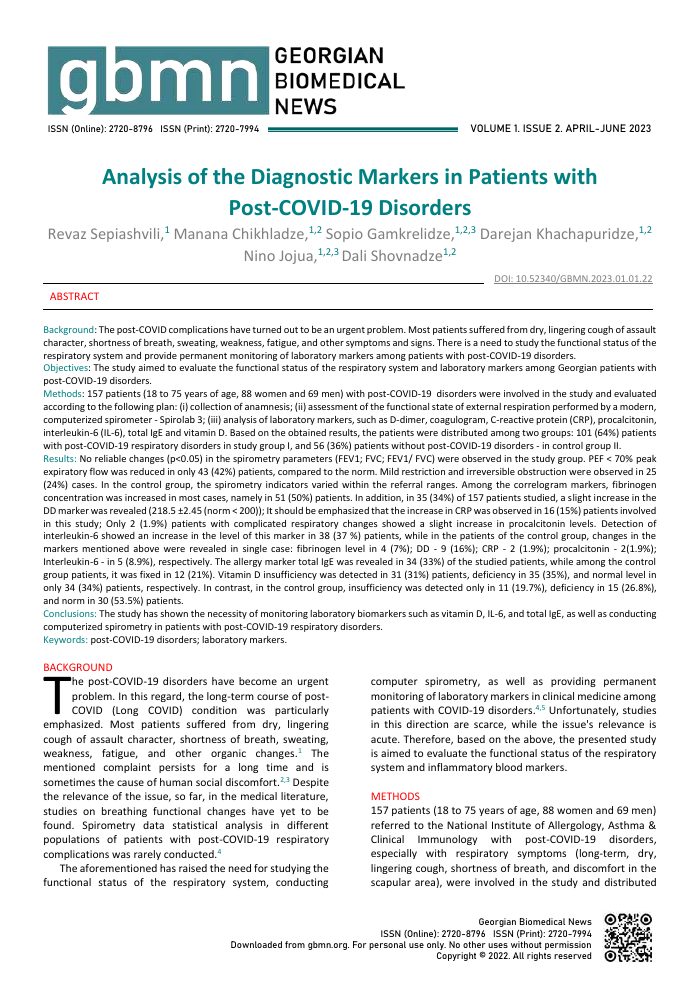
Downloads
Published
2023-05-02
How to Cite
Sepiashvili, R., Chikhladze, M., Gamkrelidze, S., Khachapuridze, D., Jojua, N., & Shovnadze, D. (2023). Analysis of the Diagnostic Markers in Patients with Post-COVID-19 Disorders. Georgian Biomedical and Medical Nexus, 1(2), 85-87. https://doi.org/10.52340/GBMN.2023.01.01.22