
The External Radiation Dose of the Population Tbilisi, Georgia
DOI:
https://doi.org/10.52340/GBMN.2024.01.01.78Keywords:
Annual dose, ionizing radiation, natural radioactivityAbstract
Background: Ionizing radiation constitutes a significant environmental factor of concern. Numerous countries study natural radiation levels in unrestricted and restricted areas. Understanding natural radioactivity is crucial for assessing potential radiological risks to human health and implementing necessary local controls. Objectives: This study aims to assess the average annual external radiation doses received by the population of Tbilisi. Methods: The research employed a РКСВ-104 portable dosimeter capable of calculating gamma radiation equivalent doses within the range of 0.1-99.99 µZv/h. Results: The study assessed radiation levels in 60 points (360 observations) in open areas and 80 points (480 observations) in closed areas across various municipalities in Tbilisi. Data analysis was conducted using Microsoft Excel. The average annual external radiation dose for the Tbilisi population, excluding radon exposure, was found to be 0.9 mZv/year. This figure slightly exceeds the upper limits reported in European countries (0.6-0.8 mZv/year). Conclusions: Based on the study findings and considering that one-third of the total radiation exposure originates from external sources and the remaining two-thirds from internal sources, the average annual total radiation dose (external and internal combined) for the population in the study area is likely relatively high. Therefore, implementing preventive measures to mitigate these exposures is recommended.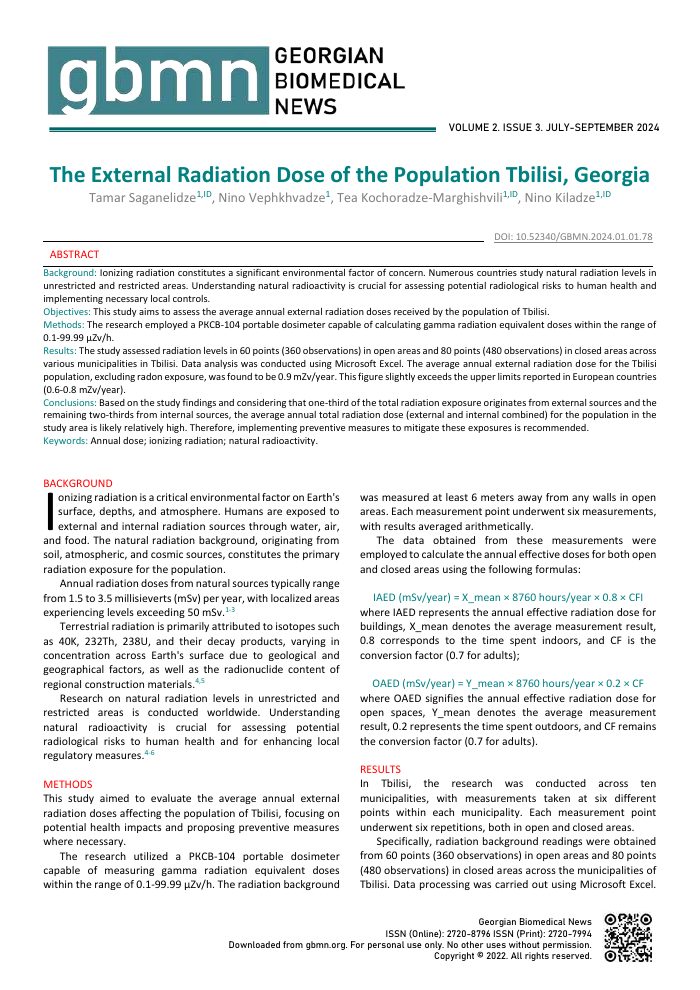
Downloads
Published
2024-07-22
Issue
Section
Original Research
Categories
How to Cite
Saganelidze, T., Vephkhvadze, N., Kochoradze-Marghishvili, T., & Kiladze, N. (2024). The External Radiation Dose of the Population Tbilisi, Georgia. Georgian Biomedical and Medical Nexus, 2(3), 133-135. https://doi.org/10.52340/GBMN.2024.01.01.78