Successful Urgent Surgical Repair of an Intact 11.2-cm Ascending Aortic Aneurysm with Severe Secondary Aortic Regurgitation: A Case Report
DOI:
https://doi.org/10.52340/GBMN.2026.01.01.182Keywords:
Aortic regurgitation, Ascending aortic aneurysm, Bentall procedure, Del Nido cardioplegia, Giant aneurysmAbstract
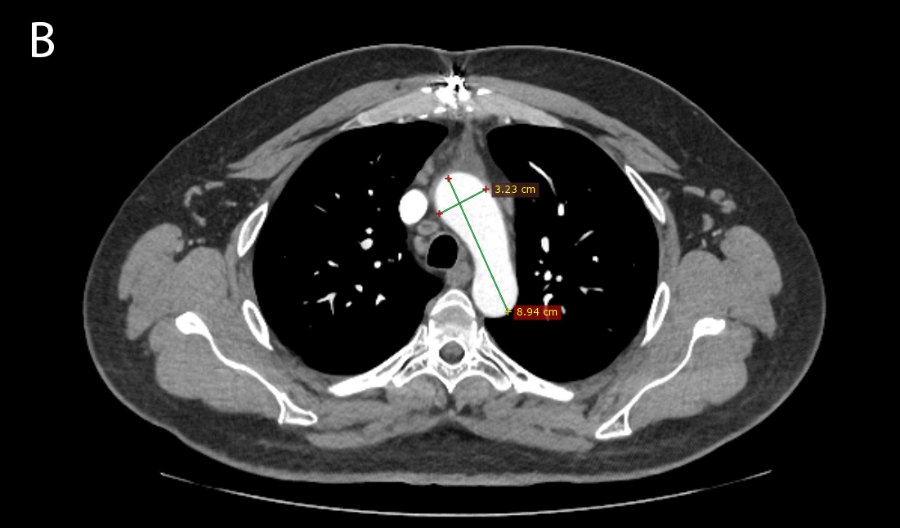
Giant ascending aortic aneurysms (>10 cm) are uncommon because most thoracic aortic aneurysms are detected or become complicated before reaching this size. Nonspecific cardiopulmonary symptoms and mass effect may dominate their clinical presentation. A 44-year-old man with a 2-month history of progressive retrosternal discomfort, dyspnea, fatigue, and reduced exercise tolerance was transferred urgently after an acute worsening of chest pain and dyspnea. He had previously been treated empirically for presumed atypical pneumonia without improvement. Computed tomography angiography demonstrated an intact, non-dissected proximal ascending aortic aneurysm measuring 10.7×11.2 cm, without contrast extravasation or periaortic hematoma. Transthoracic echocardiography demonstrated severe secondary aortic regurgitation, marked left ventricular dilation (LVEDD 7.0 cm; LVEDV 189 mL), and an LVEF of 45%. After blood-pressure control and hemodynamic stabilization, the patient underwent urgent composite aortic root/ascending aortic replacement using a Bentall technique with a 25-mm mechanical bileaflet valve and a 30-mm woven Dacron graft. Myocardial arrest was achieved with ostial Del Nido cardioplegia. The patient was extubated 4 hours postoperatively. At 3 months, he reported complete resolution of dyspnea and chest pressure and was in NYHA functional class I. Follow-up CTA demonstrated stable graft reconstruction without perigraft collection, pseudoaneurysm, or prosthetic dehiscence. This case illustrates that an intact giant ascending aortic aneurysm may present with misleading respiratory symptoms and severe secondary aortic regurgitation. Prompt cross-sectional imaging and definitive surgery can achieve a favorable early outcome even in extreme aortic dilation. No causal inference regarding the superiority of a specific cardioplegia strategy can be made from a single case.References
Davies RR, Goldstein LJ, Coady MA, Tittle SL, Rizzo JA, Kopf GS, Elefteriades JA. Yearly rupture or dissection rates for thoracic aortic aneurysms: simple prediction based on size. Ann Thorac Surg. 2002;73(1):17-27; discussion 27-28. doi:10.1016/S0003-4975(01)03236-2.
Elefteriades JA. Natural history of thoracic aortic aneurysms: indications for surgery, and surgical versus nonsurgical risks. Ann Thorac Surg. 2002;74(5):S1877-S1880. doi:10.1016/S0003-4975(02)04147-4.
Isselbacher EM, Preventza O, Black JH 3rd, et al. 2022 ACC/AHA Guideline for the Diagnosis and Management of Aortic Disease: A Report of the American Heart Association/American College of Cardiology Joint Committee on Clinical Practice Guidelines. Circulation. 2022;146(24):e334-e482. doi:10.1161/CIR.0000000000001106.
Mazzolai L, Teixido-Tura G, Lanzi S, et al. 2024 ESC Guidelines for the management of peripheral arterial and aortic diseases. Eur Heart J. 2024;45(36):3538-3700. doi:10.1093/eurheartj/ehae179.
Coady MA, Rizzo JA, Hammond GL, et al. What is the appropriate size criterion for resection of thoracic aortic aneurysms? J Thorac Cardiovasc Surg. 1997;113(3):476-491. doi:10.1016/S0022-5223(97)70360-X.
Agarwal V, Yaliwal C, Ofo E, Kolvekar S. Giant ascending aortic aneurysm--a case report and review. Heart Lung Circ. 2007;16(5):385-388. doi:10.1016/j.hlc.2006.09.009.
Moutakiallah Y, Ait Houssa M, Seghrouchni A, et al. A giant aneurysm of ascending aorta revealed by superior vena cava syndrome. Heart Lung Circ. 2014;23(12):e264-e266. doi:10.1016/j.hlc.2014.08.001.
Bicer M, Yuksel A, Kan II. The largest reported giant ascending aortic aneurysm presented with superior vena cava syndrome. Braz J Cardiovasc Surg. 2020;35(5):834-837. doi:10.21470/1678-9741-2019-0151.
Dumani S, Likaj E, Dibra L, Ibrahimi A, Baboci A. Giant aneurysm of ascending aorta and aortic arch: a report of a rare case. Cureus. 2024;16(4):e59393. doi:10.7759/cureus.59393.
Mitsali T, Dewi DK, Hilman. Giant ascending aortic aneurysm: a rare case report. Radiol Case Rep. 2025;20(6):2797-2801. doi:10.1016/j.radcr.2025.02.030.
Matte GS, del Nido PJ. History and use of del Nido cardioplegia solution at Boston Children’s Hospital. J Extra Corpor Technol. 2012;44(3):98-103.
Ad N, Holmes SD, Massimiano PS, Rongione AJ, Fornaresio LM, Fitzgerald D. The use of del Nido cardioplegia in adult cardiac surgery: a prospective randomized trial. J Thorac Cardiovasc Surg. 2018;155(3):1011-1018. doi:10.1016/j.jtcvs.2017.09.146.
Gagnier JJ, Kienle G, Altman DG, Moher D, Sox H, Riley D; CARE Group. The CARE guidelines: consensus-based clinical case reporting guideline development. J Med Case Rep. 2013;7:223. doi:10.1186/1752-1947-7-223.