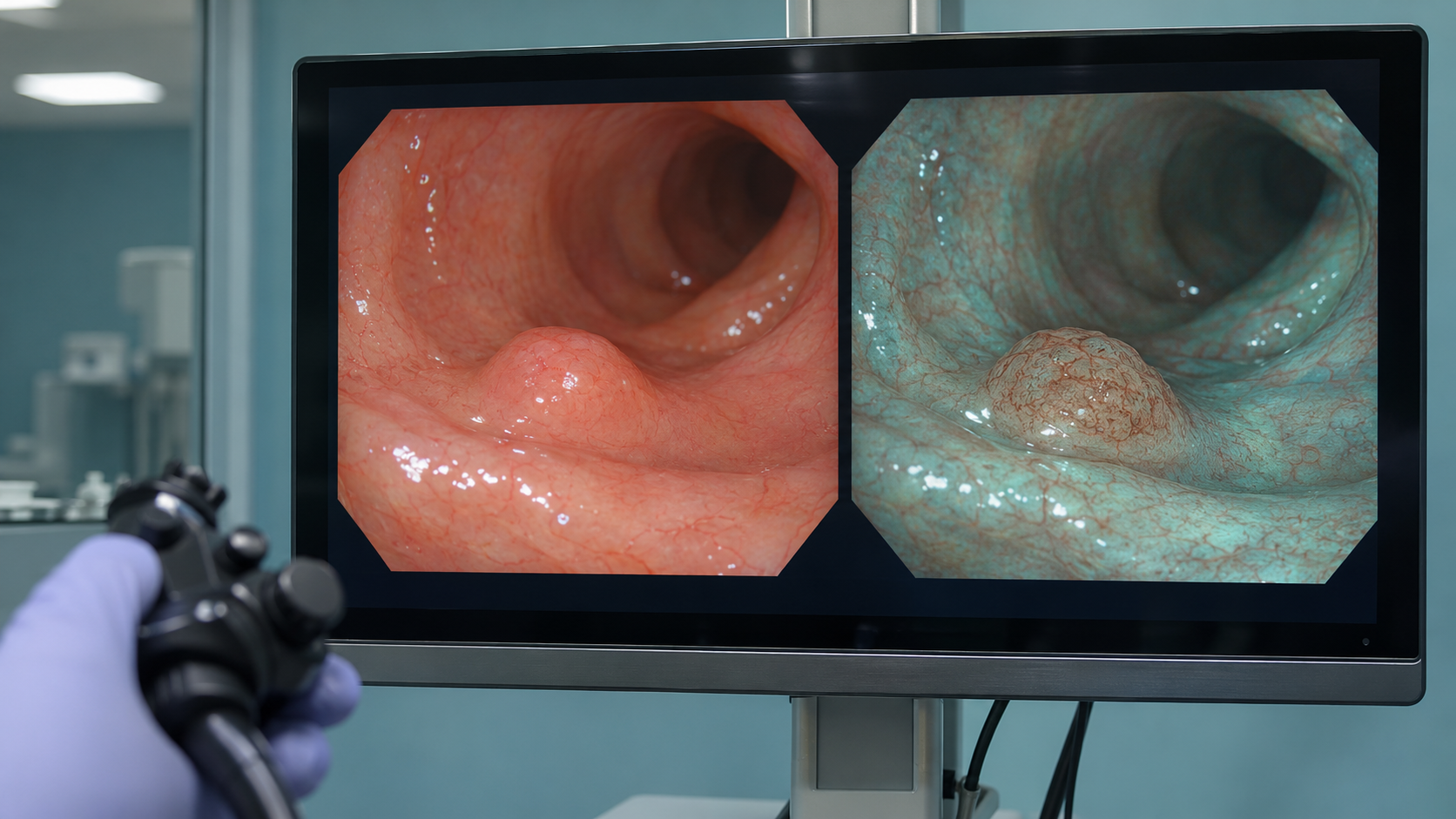
Endoscopic Characterization and Management of Colorectal Polyps
DOI:
https://doi.org/10.52340/GBMN.2026.01.01.194Keywords:
Colorectal cancer prevention, Colorectal polyps, Colonoscopy, Endoscopic imaging, Endoscopic resection, Narrow-band imaging (NBI), Optical diagnosisAbstract
Colorectal polyps are among the most frequently detected lesions during colonoscopy and represent a heterogeneous group with diverse histopathological characteristics and malignant potential. Their accurate detection and management are fundamental to effective colorectal cancer prevention. Recent advances in endoscopic imaging, including high-definition white-light and narrow-band imaging (NBI), have improved optical diagnosis, enabling endoscopists to predict histopathology, identify advanced neoplasia, and estimate submucosal invasion risk to facilitate therapeutic decision-making. This narrative review bridges validated optical classification systems with risk-based therapeutic selection, providing an integrated perspective on endoscopic diagnosis and management. We conducted a narrative literature review using MEDLINE/PubMed, Embase, and the Cochrane Library to synthesize evidence on colorectal polyp detection, optical classification, AI-assisted diagnosis, and endoscopic resection strategies. This review examines key frameworks, including NICE, WASP, and JNET, alongside morphological criteria that guide selection of cold or hot snare polypectomy, endoscopic mucosal resection (EMR), and endoscopic submucosal dissection (ESD). Optical diagnosis complements, rather than replaces, formal histopathology and requires validated training and high diagnostic confidence.
References
1. Meseeha M, Dsouza R, Attia M. Colorectal Polyps and Polyposis Syndromes. In: StatPearls [Internet]. Treasure Island (FL): StatPearls Publishing; 2026 Jan. [cited 2026 Jul 6.
2. WHO Classification of Tumours Editorial Board. Digestive system tumours. 5th ed. Lyon: International Agency for Research on Cancer; 2019.
3. Johnson GGRJ, Helewa R, Moffatt DC, et al. Colorectal polyp classification and management of complex polyps for surgeon endoscopists. Can J Surg. 2023;66(5): E491-E498.
4. Shussman N, Wexner SD. Colorectal polyps and polyposis syndromes. Gastroenterol Rep (Oxf). 2014;2(1):1-15.
5. Kashida H. Endoscopic diagnosis of sessile serrated polyp: A systematic review. Dig Endosc. 2019;31(1):16–23).
6. Jung P, Kim HW, Park SB, et al. Clinical and endoscopic characteristics of sessile serrated lesions with dysplasia/carcinoma. Korean J Intern Med. 2023;38(3):349-361.
7. Utsumi T, Yamada Y, Diaz-Meco MT, Moscat J, Nakanishi Y. Sessile serrated lesions with dysplasia: Is it possible to nip them in the bud? J Gastroenterol. 2023;58(8):705-717.
8. Gupta V, East JE. Optimal endoscopic treatment and surveillance of serrated polyps. Gut Liver. 2020;14(4):423-429.
9. Galuppini F, Fassan M, Mastracci L, Gafà R, Lo Mele M, Lazzi S, et al. The histomorphological and molecular landscape of colorectal adenomas and serrated lesions. Pathologica. 2021;113(3):218-229.
10. Sullivan BA, Noujaim M, Roper J. Cause, epidemiology, and histology of polyps and pathways to colorectal cancer. Gastrointest Endosc Clin N Am. 2022;32(2):177-194.
11. Mathews AA, Draganov PV, Yang D. Endoscopic management of colorectal polyps: From benign to malignant polyps. World J Gastrointest Endosc. 2021;13(9):356-370.
12. Participants in the Paris Workshop. The Paris endoscopic classification of superficial neoplastic lesions: esophagus, stomach, and colon. Gastrointest Endosc. 2003;58(6 Suppl):S3-S43.
13. Kaminski MF, Thomas-Gibson S, Bugajski M, Bretthauer M, Rees CJ, Dekker E, et al. Performance measures for lower gastrointestinal endoscopy: a European Society of Gastrointestinal Endoscopy (ESGE) quality improvement initiative. United European Gastroenterol J. 2017;5(3):309-334.
14. Kaltenbach T, Anderson JC, Burke CA, Dominitz JA, Gupta S, Lieberman D, et al. Endoscopic removal of colorectal lesions: recommendations by the US Multi-Society Task Force on Colorectal Cancer. Gastrointest Endosc. 2020;91(3):486-519.e1.
15. Vu NTH, Le HM, Vo DTN, Le NQ, Ho DDQ, Quach DT. Endoscopic characteristics and performance of WASP classification in the diagnosis of colorectal sessile-serrated lesions in Vietnamese patients. JGH Open. 2024;8(6): e13109.
16. IJspeert JEG, Bastiaansen BAJ, van Leerdam ME, Meijer GA, van Eeden S, Sanduleanu S, et al. Development and validation of the WASP classification system for optical diagnosis of adenomas, hyperplastic polyps and sessile serrated adenomas/polyps. Gut. 2016;65(6):963-70.
17. Hewett DG, Kaltenbach T, Sano Y, Tanaka S, Saunders BP, Ponchon T, Soetikno R, Rex DK. Validation of a simple classification system for endoscopic diagnosis of small colorectal polyps using narrow-band imaging. Gastroenterology. 2012;143(3):599-607.e1.
18. Hayashi N, Tanaka S, Hewett DG, Kaltenbach TR, Sano Y, Ponchon T, Saunders BP, Rex DK, Soetikno RM. Endoscopic prediction of deep submucosal invasive carcinoma: validation of the narrow-band imaging international colorectal endoscopic (NICE) classification. Gastrointest Endosc. 2013;78(4):625-632.
19. Sano Y, Tanaka S, Kudo SE, Lambert R, Saito S, Yamano H, et al. Narrow-band imaging (NBI) magnifying endoscopic classification of colorectal tumors proposed by the Japan NBI Expert Team. Dig Endosc. 2016;28(5):526-533.
20. Saito Y, Sakamoto T, Dekker E, Pioche M, Probst A, Ponchon T, et al. First report from the International Evaluation of Endoscopic Classification of the Japan NBI Expert Team: international multicenter web trial. Dig Endosc. 2024;36(4):591-599.
21. Gao P, Zhou K, Su W, Yu J, Zhou P. Endoscopic management of colorectal polyps. Gastroenterol Rep (Oxf). 2023;11: goad027.
22. Zhang Y, Chen HY, Zhou XL, Pan WS, Zhou XX, Pan HH. Diagnostic efficacy of the Japan Narrow-Band-Imaging Expert Team and pit pattern classifications for colorectal lesions: A meta-analysis. World J Gastroenterol. 2020 Oct 28;26(40):6279-6294.
23. Bisschops R, East JE, Hassan C, et al. Advanced imaging for detection and differentiation of colorectal neoplasia: European Society of Gastrointestinal Endoscopy (ESGE) Guideline – Update 2019. Endoscopy. 2019;51(12):1155-1179. doi:10.1055/a-1031-7657.
24. Castillo-Regalado E, Uchima H. Endoscopic management of difficult laterally spreading tumors in colorectum. World J Gastrointest Endosc. 2022;14(3):113-128.
25. Bogie RMM, Veldman MHJ, Snijders LARS, Winkens B, Kaltenbach T, Masclee AAM, Matsuda T, Rondagh EJA, Soetikno R, Tanaka S, Chiu HM, Sanduleanu-Dascalescu S. Endoscopic subtypes of colorectal laterally spreading tumors (LSTs) and the risk of submucosal invasion: a meta-analysis. Endoscopy. 2018;50(3):263-282.
26. Haggitt RC, Glotzbach RE, Soffer EE, Wruble LD. Prognostic factors in colorectal carcinomas arising in adenomas: implications for lesions removed by endoscopic polypectomy. Gastroenterology. 1985;89(2):328-336.
27. Kikuchi R, Takano M, Takagi K, Fujimoto N, Nozaki R, Fujiyoshi T, Uchida Y. Management of early invasive colorectal cancer: Risk of recurrence and clinical guidelines. Dis Colon Rectum. 1995;38(12):1286-1295.
28. Zwager LW, Bastiaansen BAJ, Montazeri NSM, Hompes R, Barresi V, Ichimasa K, et al. Deep submucosal invasion is not an independent risk factor for lymph node metastasis in T1 colorectal cancer: a meta-analysis. Gastroenterology. 2022;163(1):174-189.
29. Ferlitsch M, Hassan C, Bisschops R, et al. Colorectal polypectomy and endoscopic mucosal resection: European Society of Gastrointestinal Endoscopy (ESGE) Guideline – Update 2024. Endoscopy. 2024;56(7):516-545. doi:10.1055/a-2304-3219.
30. Shaukat A, Kaltenbach T, Dominitz JA, et al. Endoscopic Recognition and Management Strategies for Malignant Colorectal Polyps: Recommendations of the US Multi-Society Task Force on Colorectal Cancer. Gastroenterology. 2020;159(5):1916-1934.e2.
31. Gupta S, Lieberman D, Anderson JC, Burke CA, Dominitz JA, Kaltenbach T, Robertson DJ, Shaukat A, Syngal S, Rex DK. Recommendations for Follow-Up After Colonoscopy and Polypectomy: A Consensus Update by the US Multi-Society Task Force on Colorectal Cancer. Gastroenterology. 2020;158(4):1131–1153.e5.
32. Hassan C, Antonelli G, Dumonceau JM, Regula J, Bretthauer M, Chaussade S, et al. post-polypectomy colonoscopy surveillance: European Society of Gastrointestinal Endoscopy (ESGE) Guideline—Update 2020. Endoscopy. 2020;52(8):687-700.
33. Foroutan F, Wang Y, Barrowman N, et al. Computer aided detection and diagnosis of polyps in adult patients undergoing colonoscopy: a living clinical practice guideline. BMJ. 2025;388.
34. Bretthauer M, Ahmed J, Antonelli G, et al. Use of computer- assisted detection (CADe) colonoscopy in colorectal cancer screening and surveillance: European Society of Gastrointestinal Endoscopy (ESGE) Position Statement. Endoscopy. 2025;57(6):667-673.
35. Shinozaki S, Watanabe J, Kanno T, Yuan Y, Yano T, Yamamoto H, et al. Computer-aided diagnosis for colorectal polyp in comparison with endoscopists: Systematic review and meta-analysis. Dig Endosc. 2025;37(9):933-947.
36. Dekker E, Houwen BBSL, Puig I, et al. Curriculum for optical diagnosis training in Europe: European Society of Gastrointestinal Endoscopy (ESGE) Position Statement. Endoscopy. 2020;52(10):899-923. doi:10.1055/a-1231-5123.